
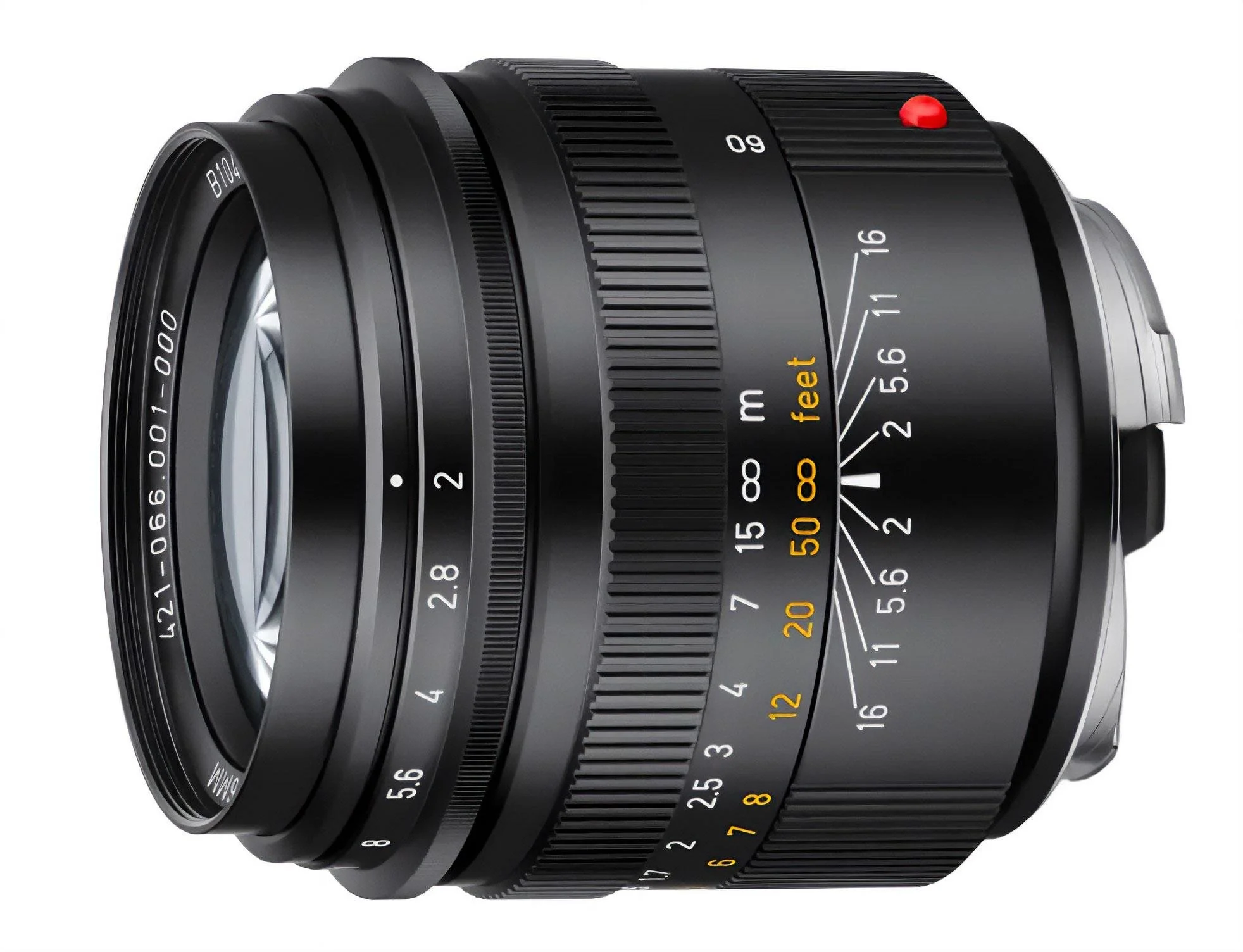
From covert US Navy photography to a 660-piece collector's edition, this may be Leica's most fascinating lens story of the year.
Some Leica products are interesting because of their technology. Others are interesting because of their history.
The new Summicron-M 66 f/2 manages to be both.
In the late 1960s, legendary optical designer Walter Mandler developed an unusual 66mm f/2 lens at Ernst Leitz Canada. Known as the Elcan 66mm, it was created for a US Navy reconnaissance application.
Only around 200 examples of the original lens were manufactured.
In September 2026, Leica resurrected the concept as the Summicron-M 66 f/2, producing a limited run of 660 lenses.
Why 66mm?
A 66mm focal length sits between the familiar 50mm and 75mm options.
Compared with a 50mm lens, it offers a tighter perspective and slightly more working distance for portraits. Compared with a 75mm, it retains a little more context and can feel less restrictive in everyday photography.
On a full-frame camera, a 66mm lens has a horizontal angle of view of roughly 30 degrees.
That makes it particularly attractive for intimate portraits, details, travel and environmental studies.
But the historical appeal is just as strong.
Leica has recreated the unusual details
The modern lens deliberately references the military original. Its aperture ring rotates in the opposite direction from conventional Leica M lenses, while the distance-scale arrangement follows the original military specification.
Even the typography and engraved optical calculation references contribute to the story.
These aren't details that improve image quality. They're details that make a lens feel like a piece of photographic history.
The collector's question
With only 660 examples and a launch price of €9,850, this is unquestionably a collector-oriented release.
The first numbered example, serial 001, is scheduled to be auctioned at Leitz Photographica Auction in Wetzlar in November 2026.
That auction could become an interesting indicator of collector enthusiasm, although a unique serial number is not a reliable measure of the resale value of ordinary production examples.
Our take
This is Leica doing something few other camera manufacturers could pull off: turning a little-known piece of military optical history into a modern photographic instrument.
And the strangest part? We suspect some photographers will discover that 66mm is a genuinely wonderful focal length.